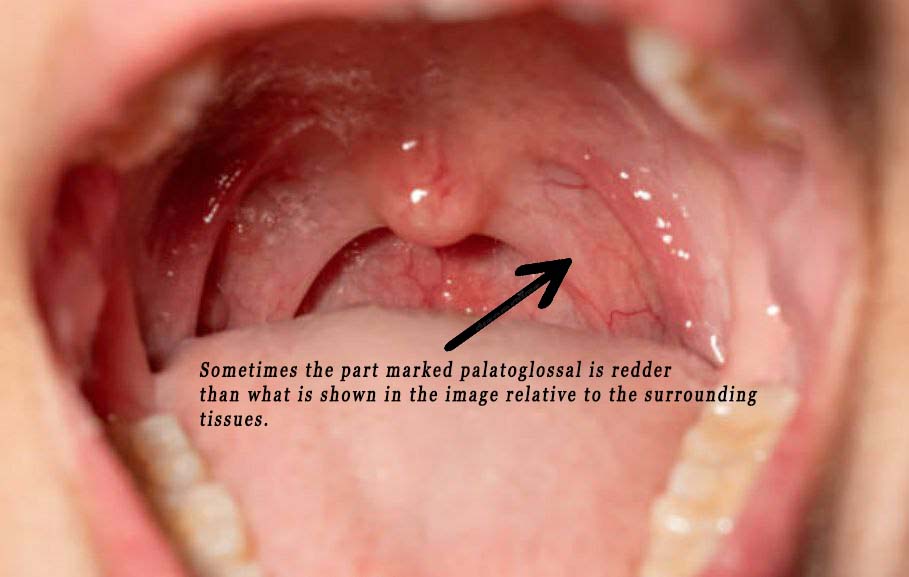
What Does This Normal Variation Look Like?
In a significant number of individuals, the mucosa covering the palatoglossal arches (the muscular pillars at the back of the throat on either side of the uvula) appears as a deep, dusky red color. This contrasts sharply with the lighter pink or red of the surrounding throat tissues.
- Appearance: The patches are red, flat (macular), and form band-like areas.
- Location: They are almost always found on both sides (bilateral), though the size and shape may not be perfectly symmetrical.
- Sensation: They are entirely painless and not associated with soreness or irritation.
- Persistence: Unlike a infection, these red bands remain unchanged over time.
In some cases, particularly in individuals who have had a tonsillectomy years prior, similar red bands can also be found on the mucosa lining the tonsillar fossa (where the tonsils used to be).
Why Are These Areas So Red?
The deep red color is not a sign of inflammation. Instead, it is due to a richer blood supply (increased vasculature) in that specific tissue. This area is often associated with Waldeyer's ring, the ring of lymphoid tissue in the throat, which contributes to its highly vascular nature.
Normal vs. "Sore Throat"
deep red coloris a normal variant: It is considered an individual's normal anatomical makeup and requires no treatment. It is often misdiagnosed: Because of its prominent red color, it is frequently mistaken for pharyngitis (a "sore throat") or other inflammatory conditions.
If the red areas are painless, symmetrical, and have been present long-term without changing, they are likely this normal variant. However, any new, painful, ulcerated, or rapidly changing lesion in the mouth or throat should be evaluated by a healthcare professional to rule out pathology
Resource: DIFFERENTIAL DIAGNOSIS of ORAL and MAXILLOFACIAL LESIONS
NORMAN K. WOOD | PAUL W. GOAZ